Submitted by Ben Gladwin and family
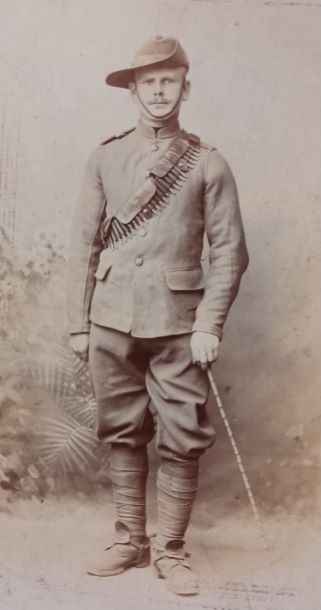
Albert Woodward had an exceptional life and a remarkable military career serving three British monarchs. He was born on May 8th 1876 in Nottingham. His first trade was as a groom, and at 18 he enlisted into the Sherwood Foresters (Nottinghamshire and Derbyshire Regiment), with service number 4922 having briefly served in the militia. Militia units were part-time non-professional soldiery that assisted in home defence and national emergencies, and occasionally served overseas. They were the forerunners of the British Territorial Army and, in the USA, the National Guard.
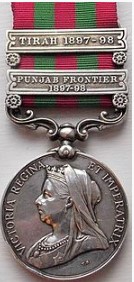
After basic training, he was quickly deployed with the 2nd Battalion to India to take part in the century-long North West Frontier campaign. This was a series of brutally fought expeditions which had two major aims. The first was to prevent tribal raiding from the mountainous regions into the lowlands under British control; the second was to deter a full-scale Russian invasion from the north into British imperial territory. Albert was commended for his participation in the Tirah Campaign (1897-98) that was fought to restore British control of the strategically vital Khyber Pass. For his service in India, he was awarded the India Medal with two clasps.
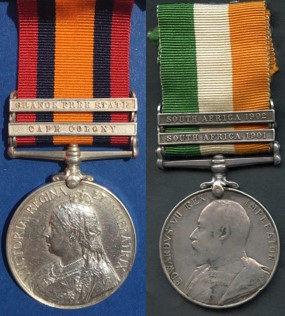
The 2nd Battalion was then withdrawn to Malta until 1902, but Albert transferred by his own request to the 1st Battalion to see service in the Second Anglo-Boer War in South Africa (1899-1902). He remained there until 1902, having first served under General Sir William Gatacre in the Orange Free State, and then under General Bruce Hamilton as part of the 21st Infantry Brigade. For both engagements, he was awarded the Queen’s South Africa medal with two clasps: Orange Free State and Cape Colony, and the King’s South Africa medal.
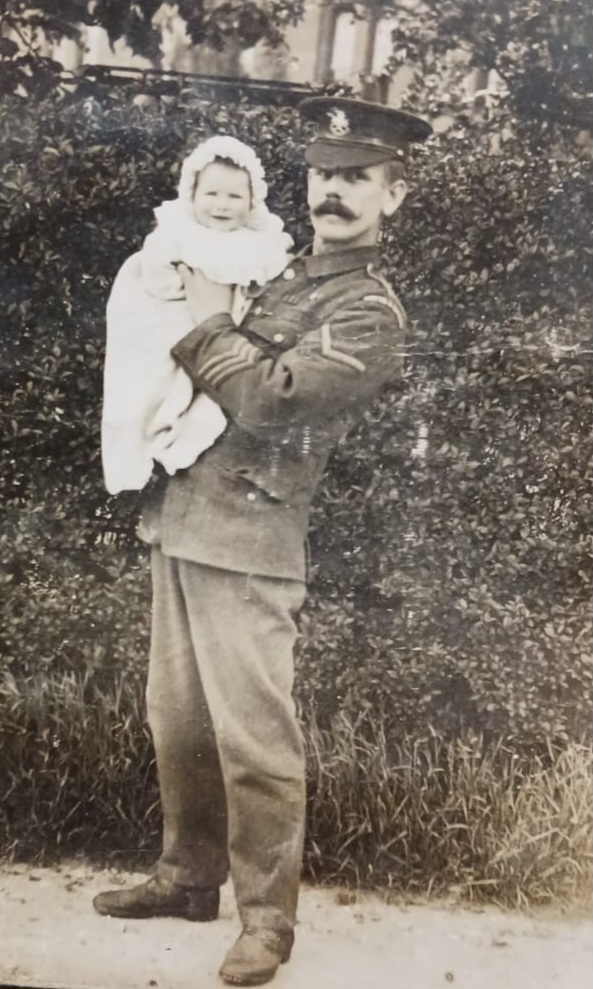
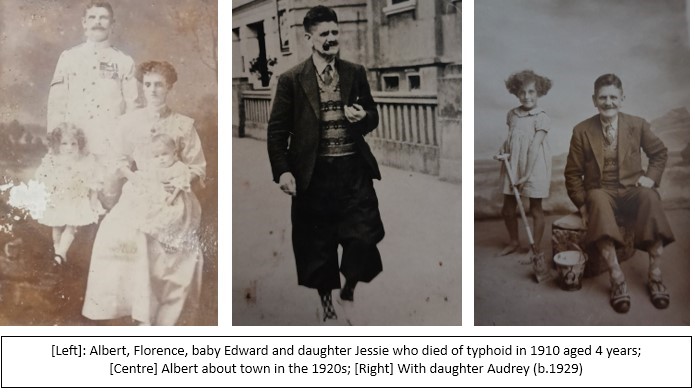
At the age of 26 in September 1902, he stepped down from the regular forces into the reserves with the rank of Lance Corporal. Three years later he took a wife, Florence Ada Riley. While in the reserves, he was promoted twice in 1908 and 1911, first to Corporal and then to the rank of Sergeant. He had returned to India with the reserves, almost certainly with the Labour Corps, and there Florence gave birth to their son, Edward Albert, in 1908.
In 1913, aged 36, it seems that Albert had decided to put soldiering behind him. He left India with his family and applied for a full discharge in January 1913, granted at Gosport two months later. He had served his contracted 18 years and his conduct was described as ‘Exemplary’. He was a highly decorated man, well respected by his peers and community, and a quiet life was something to be anticipated and cherished.
Nine months later, he was back in the army.
The growing crisis in Europe had pushed governments across the continent to strengthen reserve forces, and Albert re-joined on the 14th of December 1913 with a promotion to Warrant Officer Class 2. At first he volunteered for general service, but the Sherwood Foresters welcomed him back in September 1914 as a Company Sergeant Major in the Special Reserve. The early disasters of the British campaign, and the toll they took of the regular army, provoked the high command to mobilise reservists and territorials to strengthen the numbers, and Albert was dispatched to France on the 14th of February 1915.
In early autumn, the 2nd Battalion was outside Hooge in Belgium, part of the infamous Ypres Salient that claimed hundreds of thousands of lives. This sector was constantly bombarded by enemy artillery, and it was under sustained attack throughout the summer of 1915. The records show that Albert sustained a gunshot wound to the left thigh on October 1st. After recovering, he was relieved of front line duty and continued to serve as an officer’s orderly until the end of the war, by which time he was 42 years old.
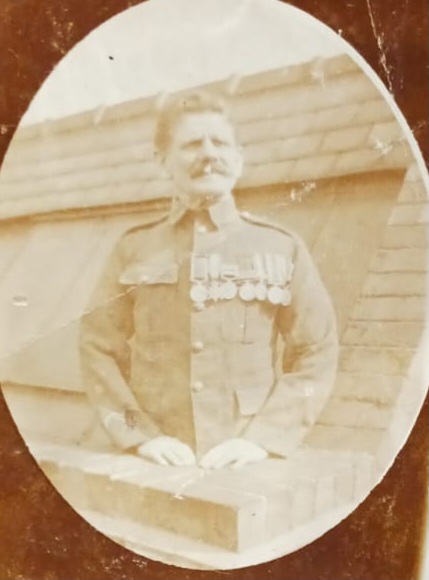
His final posting was back to India attached to the Indian Labour Corps for supervising demobilisation. He certainly qualified as an ‘old India hand’ by virtue of his earlier service, so he took his family back for another two years before finally retiring as a soldier into private life in 1921, taking with him the Long Service and Good Conduct medal along with the standard Great War medal group. He began a new career as a storeman for Boots the Chemists in his native Nottingham. The image to the left shows him in the 1930s with full decorations.
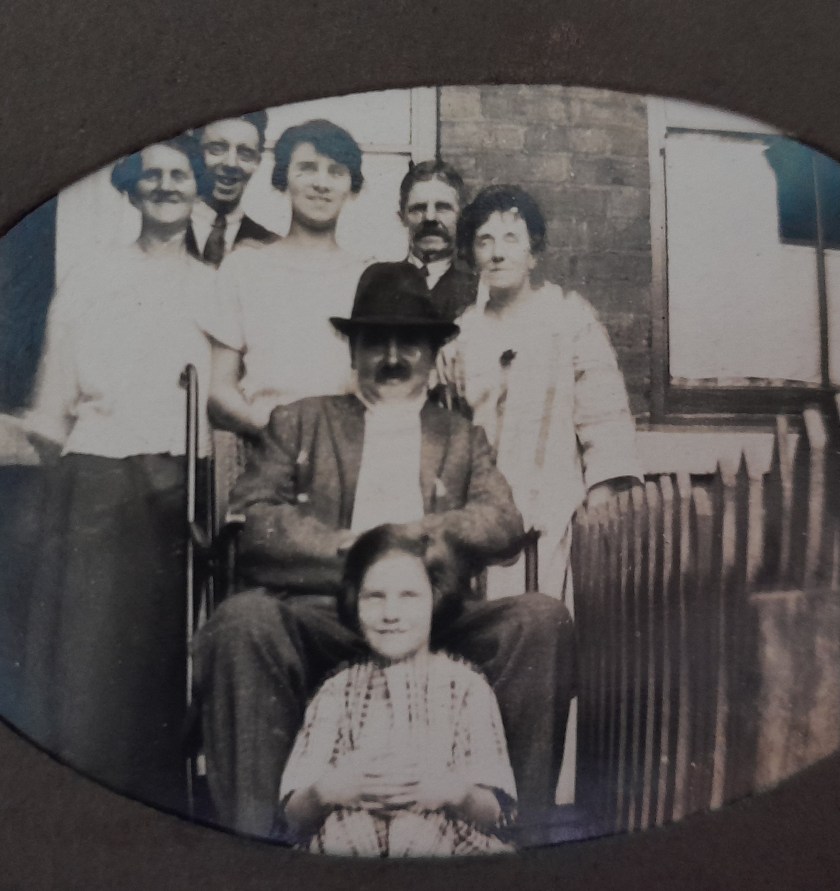
Albert Woodward died peacefully on February 6th 1940, a little short of his 64th birthday. This excellent old soldier had served under the colours of Victoria, Edward VII and George V, and no doubt he would have volunteered to fight for George VI in the Second World War had he not been too old to enlist. To the right is the last known picture of him (seated) with his family.
Unfortunately his original medals are unavailable, but the images in this post give an indication of the impressive recognition of his service.
 The History Room
Excellent documentary 👍🏻
LikeLike
Excellent 👍👍
LikeLike